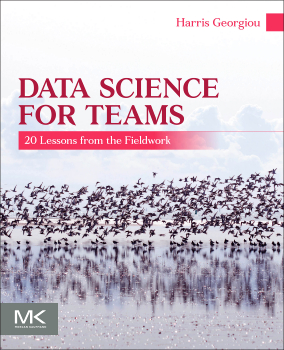
 Data Science for Teams: 20 Lessons from the fieldwork H. Georgiou Elsevier/MK. This book addresses the issue of how to deal with all team-related aspects within the context of real-world R&D projects, which are a distinct class of their own. It shows the everyday effort within the team, and the adhesive substance in between that makes everything work. Read More
Jan
26
Monday
Latest Publications
-
Data Science for Teams
Data Science for Teams: 20 Lessons from the fieldwork H. Georgiou Elsevier/MK. This book addresses the issue of how to deal with all team-related aspects within the context of real-world R&D projects, which are a distinct class of their own. It shows the everyday effort within the team, and the adhesive substance in between that makes everything work. Read More -
The Science behind COVID
 The Science behind the COVID Pandemic and Healthcare Technology Solutions - Springer book
Optimal Testing Strategies for Infectious Diseases - H. Georgiou
Mobility Analytics and COVID-19 in Greece - H. Georgiou, C. Theodoridis, Y. Theodoridis
. Read More -
Games People Play (e-Book)
-
Medical Image Analysis - Part II
 Algorithms for Medical Image Analysis – Part II: Morphological and Texture Characterization via Machine Learning (in Greek). Arnaoutis Publ., Oct-2012, ISBN: 978-9609764100 Read More
 -
Medical Image Analysis - Part I
 Algorithms for Medical Image Analysis – Part I: Applications Programming (in Greek). Arnaoutis Publ., Oct-2012, ISBN: 978-9609764094 Read More

Newsflash:
- Extending WiFi to one mile, thanks to empty TV channels ...
- "Introducing C++11", the next standard is to become official next fall ...
- Top five medical apps at Harvard Medical School ...
- Majority of applications fall short on security – even those from security vendors ...
- Everyone will be scanning barcodes with phones soon enough ...
- How Was Egypt's Internet Access Shut Off (in just 20 minutes) ...
- Millions of National Australia Bank Customers Likely Affected by Computer Glitch ...
- The bigger the system, the greater the chance of failure (ZDnet) ...
- A worm virus may be the 1st ever cyber-nuclear sabotage: "Was Stuxnet Built to Attack #Iran's Nuclea...
- Popular usernames and passwords, tag-cloud representation. Makes you wonder. ...
- Russia may send spacecraft to knock away asteroid Apophis ...
- Haiti 2010 Sahana Disaster Response Portal, already up and running. ...
- What should we teach new software developers? ...
- NASA: Interplanetary Internet Tested ...
- NASA Engineers Bring the Internet to Astronauts ...
- Moon smash - Early observations show no debris plume in the search for ice. ...
- First European commander of the International Space Station. ...
- Gigantic Air Gun To Blast Cargo Into Orbit. ...
- The Human Genome in 3 Dimensions. ...
- CCD Camera Chip Pioneers Share Nobel. ...
Planned Work

October 2015
Start of the new academic season, preparing presentations, lectures and some postponed publications.More
November 2015
Well-into the new semester, starting the core work with the new R&D project, finishing postponed publications.More
| |||||||||||||||||||||||||||||||||||||||||||||||||
Current Workload
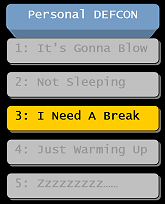
IMPORTANT: If I'm DEFCON 2 and above, please do not disturb, unless we're in war!
About Me

Who am I ?
Informatics Systems Engineer (BSc, MSc), Machine Learning & Medical Imaging researcher (PhD), working professionally as IS/IT and R&D consultant, academic teacher in the private sector, part-time software developer, full-year scuba diver and underwater photographer.
Warning: This website is just another typical personal homepage, with lots of boring stuff about my interests and work. I tried my best to make it a useful portal for students and colleagues with similar interests, but don't stay long if you start feeling a headache.



Recent Blog
-
Scientific blogging: Is it worth it?Web 2.0 technologies have enabled the merging of different types of publications into one, the Internet, with millions of authors and billions of readers. Science is not an exception. Countless articles are presented in the...
-
Remote office on demand via web 2.0Ok, let’s say you left home this morning for an important meeting and, when you got there, you discovered that you have left the presentation file and the whole USB stick plugged on the PC...
-
Reviving old hardware with LinuxA few months ago I decided it was time to replace my old laptop. It is an Acer Aspire 1302 series, with AMD AthlonXP @ 1.6 GHz, 512 MB RAM and 20 GB hard disk....
Wired News


|
|||||||||
|
<< Start < Prev 1 2 3 4 5 6 7 8 9 10 Next > End >> |
|||||||||
| Page 1 of 11 | |||||||||

Upcoming Events
 8th International Conference on Agents and Artificial Intelligence (ICAART 2016) 24-26 Feb 2016, Rome, Italy -- Deadline: 26-Oct-2015 (ext).
- 5th International Conference on Pattern Recognition Applications and Methods (ICPRAM 2016) 24-26 Feb 2016, Rome, Italy -- Deadline: 26-Oct-2015 (ext).
- Mediterranean Conference On Medical And Biological Engineering And Computing (MEDICON 2016) 31/Mar-2/Apr 2016, Paphos, Cyprus -- Deadline: 30-Oct-2015 (ext).
- 3rd International Conference on Bioimaging (BIOIMAGING 2016) 21-23 Feb 2016, Rome, Italy -- Deadline: 2-Nov-2015 (ext).
- European Symposium on Artificial Neural Networks, Computational Intelligence and Machine Learning (ESANN 2016) 27-29 Apr 2016, Bruges, Belgium -- Deadline: 20-Nov-2015.
- ESANN 2015 Advances in Learning with Kernels: Theory and Practice in a World of growing Constraints (ESANN-AL 2016) 27-29 Apr 2016, Bruges, Belgium -- Deadline: 20-Nov-2015.
 9th Hellenic Conference on Artificial Intelligence (SETN 2016) 18-20 May 2016, Thessaloniki, Greece -- Deadline: 30-Nov-2015.
Hot Downloads
- NEW! Joomla! 3.5.0 released (21-Mar-2016)
- NEW! Mozilla Firefox 45.0.1 released (19-Mar-2016)
- NEW! Mozilla Thunderbird 38.7.2 released (4-Apr-2016)
- LaTeX: LyX 2.1.4 released (30-Jul-2015)
- LaTeX: MiKTeX 2.9.5757 released (10-Jun-2015)
- BibTeX: JabRef 2.10 released (11-Mar-2014)
- Platform: Weka 3.7.12 released (16-Dec-2014)
- Windows: K-Lite Mega Codec Pack 10.0.0 (15-Aug-2013)
- Windows: Vista Codec Package 6.5.3 (5-Jun-2012)
- Antivirus: Avast! Home Edition 8.0.1489 (16-Aug-2013)
- Linux: Tiny Core 4.7.7 (08-Dec-2010)
- Linux: Lightweight Portable Security (LPS) / DoD public released (15-Nov-2010)
- Mobile: TinyEncryptor 2.05 (Java app) released (11-Dec-2009)
Quote of the day
"When a technology becomes boring, that is when the social effects become interesting." -- Clay ShirkyChoose Your Color

Take a Poll

My Location
Lurking 10-20m underwater
Attica, Greece
https://github.com/xgeorgio
Email Me